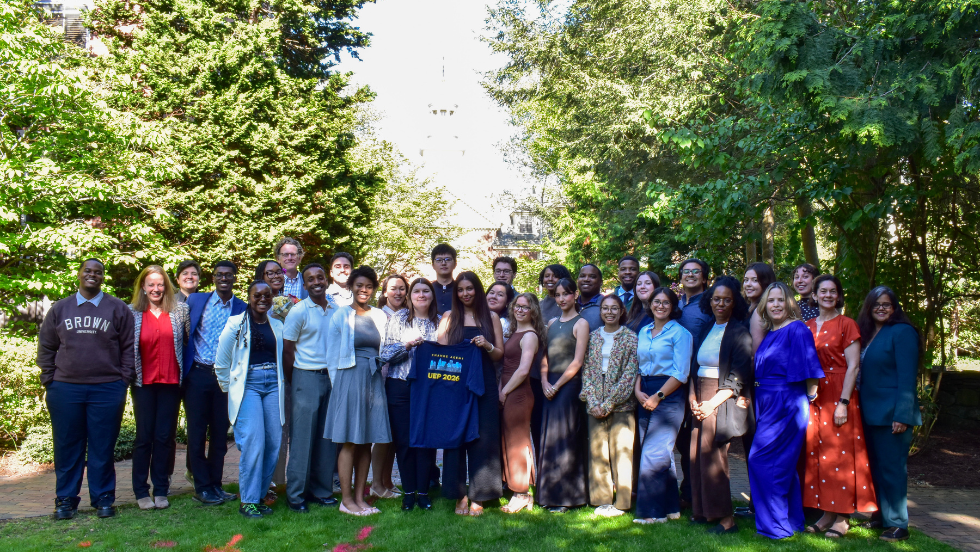
Brown Urban Education Policy students transformed their yearlong internship experiences into policy recommendations during a recent conference-style event. Attended by a network of faculty, alumni, and local civic leaders—many of whom served as supervisors for the students in their internships—the event served as a platform for students to present the synthesis of their intensive coursework and their on-the-ground residency within partner organizations.
The UEP Capstone serves as a final project for each student’s time at UEP, and it is also a professional inquiry into the mechanics of change. Throughout the year, students leverage their new learnings about creating and evaluating policy, as well as training in economic analysis and quantitative methods, to address real-time issues faced by their internship sites. These projects move beyond abstract theory, offering high-level recommendations that are deeply informed by the lived experiences of urban students and families.
“In addition to studying policy, students navigate the complexities of implementing it,” says Professor Emily Kalejs Qazilbash, Director of the UEP program. “This year’s projects highlight a sophisticated grasp of the levers for change, from analyzing AI in education to evaluating community-led advocacy programs. Their work demonstrates a commitment to ensuring that data is used thoughtfully in service of transforming the systems that serve students and families in our urban areas.”
“The internship is a cornerstone of the UEP experience,” Qazilbash continued. “By embedding themselves in organizations at the forefront of urban education reform, our students graduate with the ability to see the broad systemic landscape and the mindsets and skills to listen to the communities at the center of it.”
Below is a list of UEP students from the Class of 2026 and the titles of their capstone presentations.
Engagement, Uptake, and Implementation at the Student Level
- Cora Stone: Student Participation in After-School Programming, Providence After School Alliance
- Victoria Knox: What Gets in the Way: Barriers to Implementing High Quality Instructional Materials and Understanding the Teacher Perspective
- Leshan (Raul) Shui: Reconceptualizing Teacher Authority and Collaboration: Chinese American Parent–Child Discourse as a Lens for Family–School Communication Reform
- Arianna Mendez: Examining Middle School Career Exploration Efforts in Rhode Island
Data, Evidence, and Sustainability for Impact
- Alexis Campbell: Strengthening Implementation Practices in the Brown Tutoring Corps
- Arianna O'Brien Cannon: From Data to Decision: Designing Progress Monitoring Systems for Sustainable Literacy Improvement in Massachusetts
- Ash Horn: The Legibility Gap: Early- and Mid-Stage Evaluation, Stakeholder Logics, and Funding Sustainability in Children's Savings Account Programs
- Brian L. Martin III: Strengthening Big Picture Learning Programs Through Strategic Data Collection
- Faizaan Siddiqui: Using Artificial Intelligence Tools to Support Future Teachers in Rhode Island
- DaQuan Brown: Stories as Strategy: Qualitative Methods for Cross-Sector Nonprofit Impact
Equity-Oriented Systems Design and Access to Supports
- Diana Canales Osorio: Academic preparation for STEM success: Predictors of Performance in GSU’s CHEM 1211
- Kaylie Hanisak: Strengthening Our RI Food System: Connecting RIFPC to K-8 Stakeholders through Collaborative Outreach and Community Partnership
- Marisol Rivera Pitre: Multi-Tiered System of Support: Assessing Tier 3 interventions for multilingual learners' short-term literacy growth
- Abel Negussie: Boston Public Schools: Examining Multilingual Learners and Disability Identification in Boston Public Schools
- Marisa Sette: Understanding Access to Early Childhood Education in Rural Communities: Barriers, Policy Strategies, and Economic Context
Policy, Governance, and System Coherence
- Natalie Villacres: Boston Public Schools MLL TFM Guidance and Compliance
- Maya Anderson: Leveraging Student Activism to Drive Equity in PPSD Schools
- Jake Jackowski: Labor–Management Collaboration in US School Districts
- Julianne Meiu: Are Charter Schools Held to Different Standards? Evidence from Authorizer Performance Frameworks and Student Outcomes
- Liz Pelletier: AI and Public Good: Crafting Policy through Collective Stakeholder Input
Capacity Building and Professional Learning Systems
- Edward B. Carter: Leading the Way: Professional Learning in Rhode Island and the National Policy Playbook
- Derrick Pennix: Professional Learning: Best Practices & RIDE Recommendations
- Alexandra Mercedes-Santos: Designing for Departure: A Guidebook That Outlasts Its Author
- Aziza Alford: Stakeholder Engagement Research, Annenberg Institute at Brown University