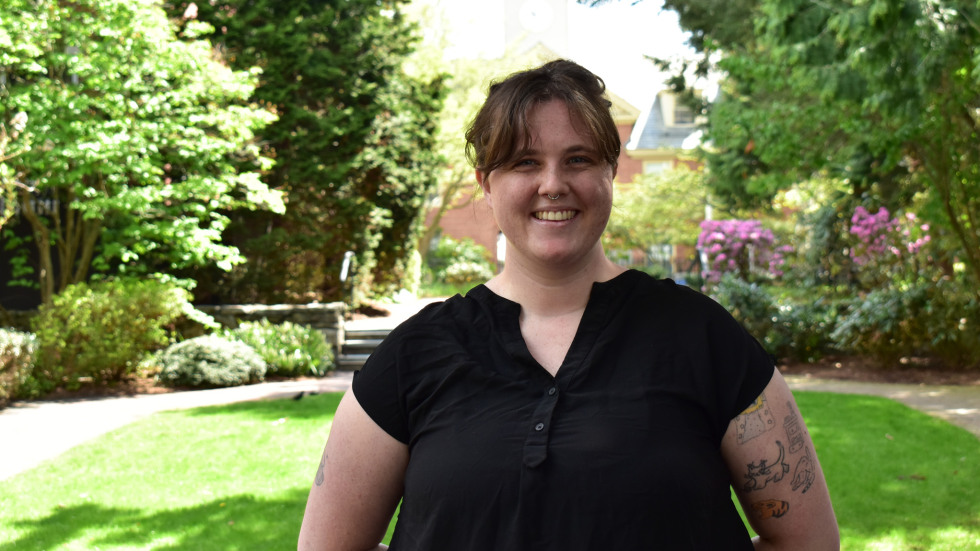
For her senior thesis, newly graduated Education Studies concentrator Ava Bradley focused on students who are both multilingual learners and recipients of special education services. Her research, titled "A Spot at the Table," asked how educators, administrators, and school staff can meaningfully engage the families of these students, as well as the challenges with engagement.
Bradley's interest in this population emerged from a reference in Dr. Tricia Kelly's course, Perspectives on Multilingual Learners in U.S. Schools. "There was a mention of dually identified students and how little literature existed on them," she recalled. Bradley shared, "I want to be an early childhood special education teacher in Rhode Island, which is a very linguistically diverse context, so I knew I would be working with dually identified students throughout my career." The family engagement angle was shaped by a second course, Dr. Yoko Yamamoto's Family Engagement in Education, as well as her own experiences as a preschool teacher navigating relationships with families firsthand.
Her study took place in a small, suburban Rhode Island school district that has seen a significant recent increase in its population of dually identified students. Through 12 semi-structured interviews with educators, administrators, and school staff, Bradley sought to understand both the challenges practitioners face and the aspirations they hold for doing this work better.
The intersecting identities of dually identified students and their families, navigating both language difference and disability, create layered challenges that don't fit neatly into existing frameworks designed for either population alone. At the same time, the staff Bradley interviewed articulated hope for more innovative, responsive approaches.
Two frameworks rooted her analysis. The Dual Capacity-Building Framework for Family-School Partnerships (Mapp & Bergman, 2019) is a research-based guide focused on building the skills, knowledge, and confidence of both school staff and families in order to strengthen partnerships. The Funds of Knowledge framework (Moll et al., 1992) offers a complementary lens, one that treats the cultural, linguistic, and experiential knowledge that families carry as genuine assets to be honored and drawn upon. Bradley found that the aspirations her interview participants expressed were consistent with both frameworks, even when they didn't name them explicitly.
Her central conclusion was that districts responding to this growing population cannot rely on one-size-fits-all engagement strategies. "The intersectional identities of dually identified students and their families entail specific and nuanced challenges," she shared, ones that call for approaches intentionally designed around their particular strengths and needs.
Her research also pointed toward what remains to be learned, including how family engagement practices ultimately connect to student outcomes for dually identified students; a question the field has yet to fully examine.
Next year, Bradley will complete the C.G.S. in Early Childhood Special Education at Rhode Island College while working full-time in a school, where she expects to work directly with dually identified students and their families. "My thesis hasn't necessarily changed my career path," she said, "but it has informed how I think about the importance of family engagement and the strategies I'll use to engage families."