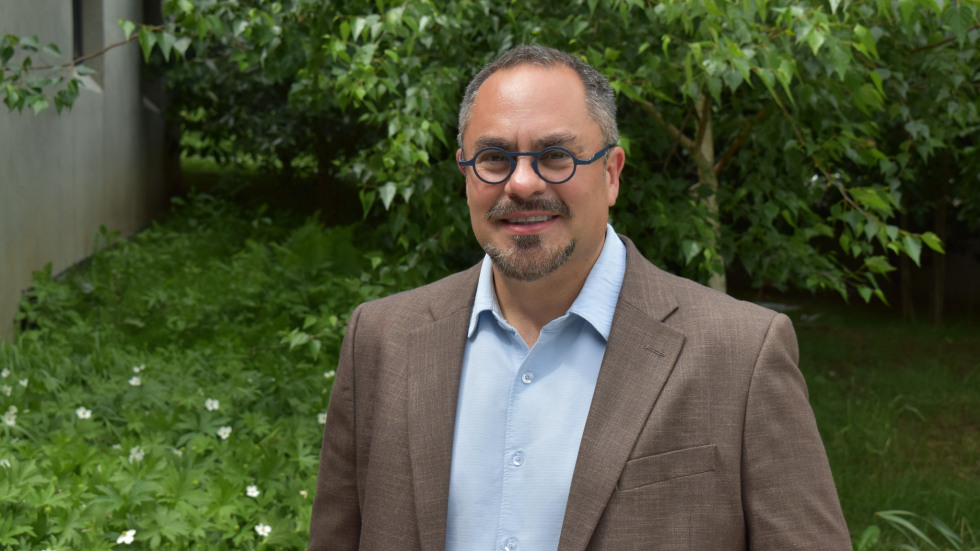
The Department of Education is thrilled to welcome Dr. David Upegui as an Assistant Teaching Professor of Education. As part of his new role, David will lead the MAT secondary science cohort. He will work full time to mentor future educators as they develop the skills and relationships needed to build rigorous and inclusive science classrooms.
David's path to Brown runs directly through Central Falls, a city where he first arrived as an immigrant student navigating a new school system. He continued to spend more than 16 years as a science teacher, coach, mentor, and Brown University Teacher Residency Site Leader at Central Falls High School. That full arc of lived experience, from student to lead educator within the same community, is central to how he thinks about teacher preparation.
"Having experienced Central Falls High School as a student, alumnus, coach, teacher, and mentor, I am deeply excited to help create a space at Brown that bridges educational policy, teacher preparation, and the lived realities of classrooms and communities," David shared.
His entry into education was shaped by mentors like his former high school teacher, Mike Householder, and college professor, Duncan White, who modeled what it looks like to show up for students and by his personal experiences. The birth of his oldest son, Isaac, who was born with Down syndrome, expanded his thinking in profound ways. "Isaac challenged me to think differently about intelligence, communication, dignity, and human potential," he reflected.
That same expansiveness carries into his vision of science education itself. "Of all school subjects, I believe science is among the most democratic," he noted, "because science doesn't care who said it, how loudly they say it, or how often they repeat it. The currency of science is publicly verifiable evidence."
David’s goal is to teach MATs flexibility and strong habits of observation, since education is so deeply contextual. At Central Falls High School, David developed and refined classroom approaches centered on storytelling as a cognitive hook, collaborative discussion structures like Question Formulation Technique and Chalk Talks, and a commitment to culturally sustaining pedagogy. He draws on the framework of students as "transformative intellectuals," a concept he credits to colleague Dr. Daniel Morales-Doyle, which reflects his conviction that when students connect science to issues of justice and community, they begin to see themselves not only as learners of science, but as people capable of using it to improve the lives of others.
For multilingual learners in particular, he is deliberate about separating language acquisition from students' capacity for sophisticated scientific thinking. He utilizes visual scaffolds, modeling, and opportunities for students to engage in their most expressive language. He plans to bring these field-tested strategies directly into the MAT program through case studies, modeling, and clinical examples from his own classroom.
Underlying David’s teaching philosophy is his conviction that rigorous science teaching and humanizing practice are not separate. "Strong science teaching is not about lowering expectations," he said. "It is about expanding access, relevance, and belonging while maintaining intellectual depth and integrity."
He is equally clear about what he hopes MAT students take away: "Students and families enter classrooms carrying vast ancestral wisdom, lived experience, and rich funds of knowledge. Our role is not to 'fix' students, but to help cultivate environments where their brilliance, curiosity, and humanity can fully emerge."
David is also looking forward to introducing the incoming MAT cohort to wisdom from his own high school students. Before leaving Central Falls High School, he asked them to record short videos with advice for the future teachers he would be training. "I want future teachers to immediately understand that students themselves are among our greatest teachers," he said.
He arrives at Brown grateful for the colleagues and scholars, including Dr. Diane Silva Pimentel, Dr. Kirstin Milks, and his doctoral advisor, Dr. David Fastovsky, whose mentorship and scholarship have shaped his own. As he begins this new chapter, David brings with him something his years in Central Falls instilled: a belief that public education, at its best, is a place where students and teachers alike are invited to flourish.