What drew you to the UEP program at Brown?
What drew me to UEP is that it focuses on urban schools specifically, instead of treating them as one small part of education policy. The big policy questions, like who governs schools, how they are funded, and how they are held accountable, look different in urban cities. Urban districts deal with state takeovers, declining enrollment, and funding formulas that don't always match the needs of the students they serve. UEP studies all of those issues with a focus on the communities most affected by them, and that is what I was looking for. The small cohort model was a big part of my decision too. I wanted to really know the people I'm learning alongside, and in a cohort this size I am learning just as much from my classmates as I am from my professors. I came up through urban schools in Los Angeles, and that shaped how I understand what students are and are not given.
Where is your internship placement and what are you working on?
I’m interning at the Rhode Island League of Charter Public Schools (RILCPS), where I focus on legislative and policy research. A big part of my role is following bills and researching how proposed legislation could affect charter public schools. Right now I’m working on a policy brief about how quickly state test results get back to families and educators, including what translation requirements look like and how other states have handled it. When results come back late, families have less time to understand how their kids are doing, and educators have less time to use that information to support their students. Since I’m planning on law school, it has been really valuable to see how education policy actually gets made at the state level.
How did your undergraduate education and any previous work experience lead or motivate you to pursue a master’s in urban education policy?
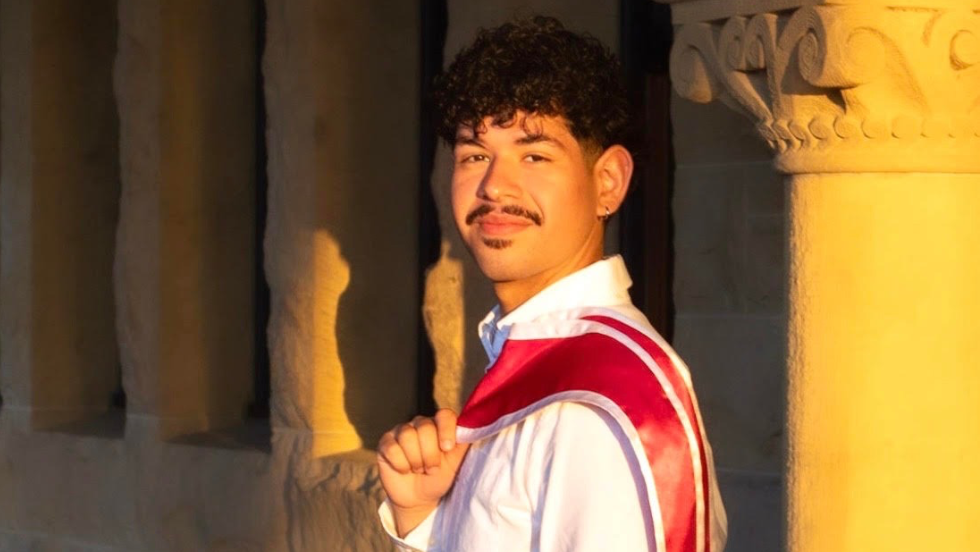
When I got to Stanford, I saw the disparities in higher education up close, in who arrives prepared, who feels like they belong, and who has someone to help them navigate it. As a first-generation college student, I was figuring a lot of that out on my own, and I started to see how many of those gaps begin before college. That led me to focus my studies on education and inequality and to do research with the Higher Education and Diversity Lab at Stanford’s Graduate School of Education. That work showed me that a lot of these gaps come down to policy decisions, and I wanted the education to work on those decisions directly.
What is your favorite part about Providence and Brown?
I love that Providence is a hub of local restaurants and coffee shops. Every day there is somewhere new to try, and it is always exciting to walk around the city and find a new spot. It makes Providence feel like there is always something to do, even during a busy week. As much as I love trying new coffee spots, I have consistently stuck with my tried and true, Coffee Exchange. If you find yourself in Providence, whether you’re visiting campus or you’ve committed to UEP, try my order: an iced latte with almond milk and sugar-free hazelnut syrup, with a sprinkle of cinnamon. After you grab your coffee, right across the street is the cutest antique and vintage store, Nostalgia Antiques & Collectibles, definitely check it out!
Who is your #1 inspiration in your life?
My siblings. I’m the youngest of five, the second to earn a bachelor’s degree, and the first to be in graduate school. My siblings have always pushed me to do my best. They have supported me at every step, from college applications to moving across the country for grad school. While academia has been unfamiliar to my eldest siblings, their hard work and character have made me who I am today, and I am forever grateful. They are not only my siblings, they are my best friends, and a lot of what I do, I do with them in mind.