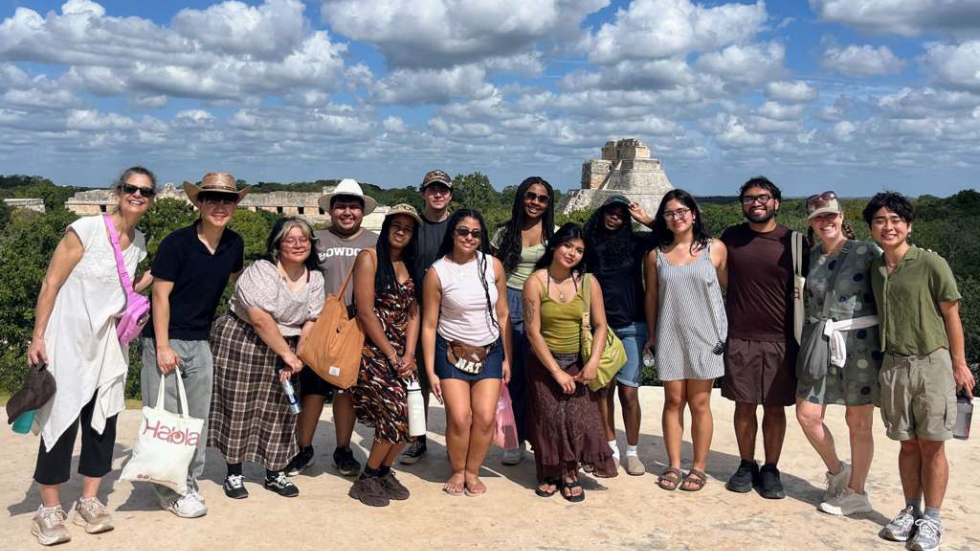
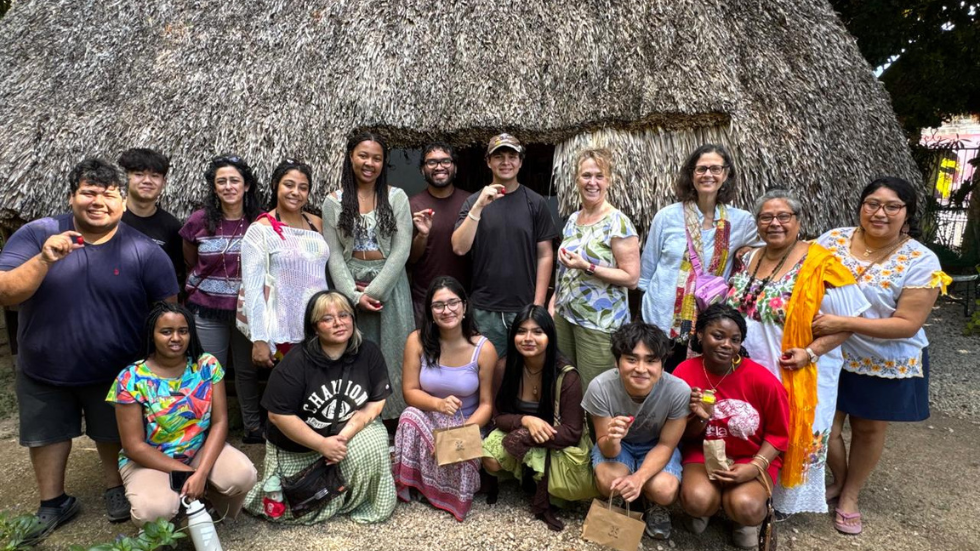
Over winter break, a cohort of Brown University students traveled to Mérida, Mexico as part of “Habla Conmigo: Cross-Cultural Language Learning and Teaching,” a Global Experiential Learning and Teaching (GELT) course led by Tricia Kelly, Assistant Teaching Professor of Education and Patricia Sobral, Teaching Professor of Portuguese and Brazilian Studies. The two-week immersive experience combined Spanish language learning, arts-based pedagogy, and cross-cultural engagement, offering students a firsthand look at how creative approaches can support multilingual learners and educators.
“Language learning is not just about vocabulary and grammar. It’s about culture, identity, and connection as well.” Professor Kelly said. “By placing students in an immersive arts-based environment, they were able to experience what culturally responsive teaching can look like in practice.”
Offered through Global Experiential Learning and Teaching (GELT) at Brown University, the winter session course began with virtual meetings over winter break before students departed on January 3. Coming so soon after a period of profound tragedy on campus, the timing of the trip felt especially poignant. The two intensive weeks of study and collaboration in the Yucatán provided a vital space for students to find community and process their experiences together away from College Hill.
Learning Through Language, Arts, and Immersion
The course was centered at Habla, a language and culture school in Mérida that uses an arts literacy framework, designed to enhance learning by integrating the arts into the teaching of Spanish. Students lived with host families and participated in Spanish immersion tailored to their proficiency levels, working in small groups with instructors through conversation-based, creative activities such as poetry and spoken word.
Drawing on the ArtsLiteracy Project, established over 25 years ago within the Education Department at Brown University and still central to Brown’s MAT program today, the course incorporated ideas from Engage: Creative Strategies for Teaching and Learning, co-authored by Kurt Wootton and Eileen Landay. Wootton and his wife Marimar Patron Vazquez, co-founders of Habla and both Brown alumni, helped shape the foundation of the program.
“Having spent many years both as students and teachers on Brown’s campus ourselves, it was a powerful experience to have Brown students here in Mérida at our school, Habla,” said Kurt Wootton and Marimar Patron Vazquez. “Throughout the students' experience here they created original work in different languages and through different artistic mediums, from performance to the visual arts. Most importantly, they created as a community, really bringing the best of many worlds and many cultures together.”
“The immersive structure of the program completely transformed the way I think about language learning and teaching,” said Jinho Lee, a senior studying Computer Science. “At Habla, we were taught Spanish not through long worksheets of conjugations, but through analyses of artwork and music… This style of learning felt much more salient to me and made me immediately invested in the material and more confident in my own abilities.”
Maria Camacho, a junior concentrating in Education and Social Analysis and Research, emphasized that the workshops helped her recognize the power and importance of community building and trust building when language learning. She shared, “Creating an environment where learners are empowered through an environment of support and trust… is integral for language learning and fostering linguistic confidence.”
Both students also reflected on the personal impact of the experience. “My biggest takeaway has been the community I was so lucky to be a part of,” Lee said. “I wanted to be in an environment where I would be surrounded by like-minded students open to collaboration and passionate about challenging the boundaries of education.” For Camacho, the trip deepened her connection to her heritage, sharing “The connection to my family and culture was the most memorable aspect that I took away.”
Connecting Mérida to Providence Classrooms
During the first week, students focused on arts literacy practices at Habla through pedagogy workshops and classroom-based learning. In the second week, the emphasis shifted toward collaboration with educators from Hope High School in Providence. Brown students worked in teams to develop instructional frameworks and lesson ideas that Hope High School teachers could adapt for their own classrooms.
“What makes this program distinctive is the bridge it builds between the Yucatán and the classrooms of Providence,” said Professor Sobral. “Watching Brown students translate their immersion in Mérida into actionable instructional frameworks for Hope High School teachers was a masterclass in global-to-local application. They weren’t just learning a language; they were learning to build educational tools that serve our local community. Beyond serving our local community, it was beautiful to witness the community our Brown students built during this experience. I have no doubt it will be an enduring one.”
The experience also included field trips to Mayan ruins, cenotes (freshwater lakes beneath caves) and coastal areas, granting students a deeper understanding of the region’s history, geography, and indigenous cultures. These shared experiences outside the classroom further reinforced the course’s emphasis on learning through observation.
Extending the Impact Beyond
After returning to Providence, students shared what they learned with local educators, helping translate their insights from Mérida into practices that could be integrated into Rhode Island classrooms.
Oliver O’Neill, a teacher at Hope high school, shared that he has already started using the resources students developed in the classroom. Specifically, role-play and character creation activities to engage students in discussions about the Second Industrial Revolution. He shares how “Role-playing in academic discussions gives students the power to imagine themselves in historical narratives, allowing them to reflect on how they as individuals would react to fast-changing times.” The activities uniquely empower students to take charge of their learning process.
Open to students from any concentration or year, the course prioritized those who had not previously traveled abroad. This resulted in a vibrant mix of participants—ranging from fully bilingual heritage speakers to those with no prior Spanish experience. This linguistic diversity deeply enriched the program, allowing students to learn as much from one another as they did from the curriculum.
Together, the reflections from faculty, students, and partner educators highlight the overarching goal of “Habla Conmigo” to connect global experience with local impact, and to show how arts, language, and teaching can intersect to create more inclusive and meaningful learning environments.