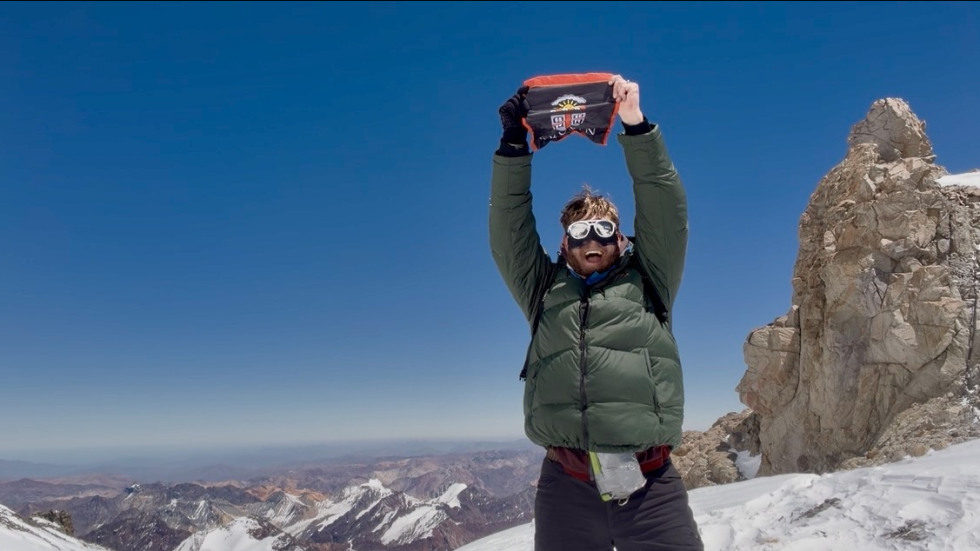
Mac Manning, a student in Brown University’s Urban Education Policy (UEP) program and Director of the Office of Military-Affiliated Students, views mountaineering as a test of resilience, discipline, and community.
His connection with the Veterans Adventure Group began after relocating to Rhode Island, when he sought after new ways to pursue high-altitude mountaineering. “I grew up hiking, backpacking and camping a ton and of course my time in the The United States Marine Corps I spent considerable time outdoors as part of training,” he explained.
After finding Veterans Adventure Group on Instagram, Manning was thrilled with the concept of being on unguided and self-organized expeditions as it provided him an opportunity to be more involved in the process.
He was drawn to the collaborative spirit of the organization: “I truly love the idea of other service members coming together to take on a challenge.”
An Expedition to Aconcagua
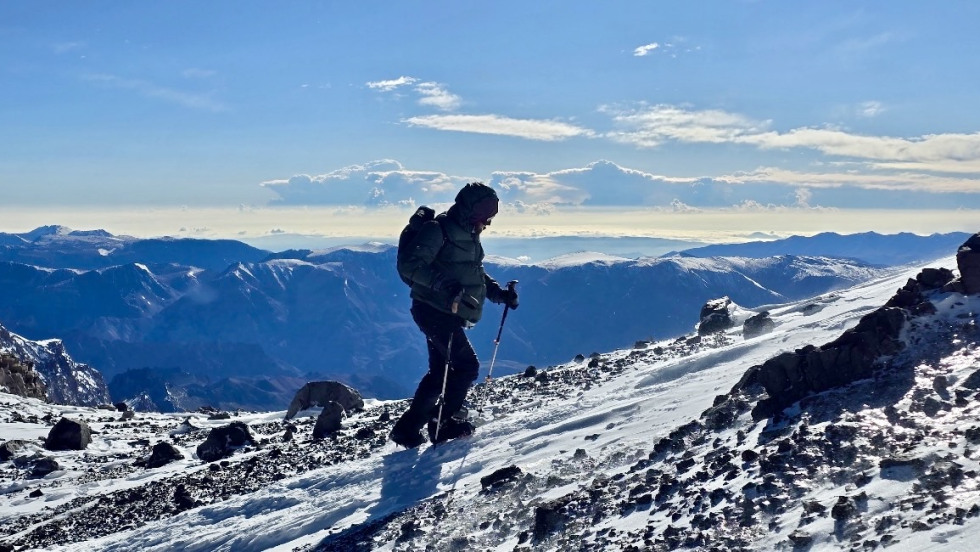
In January, Manning joined Veterans Adventure Group on an expedition to Aconcagua, the tallest mountain outside the Himalayas. The team climbed via the remote 360 route. “This often put us in between many guided expeditions and gave us much more of the mountain to ourselves,” he said.
Climbing Aconcagua demanded careful logistics and acclimatization. “To climb a big mountain you need to do two things. Manage the logistics of all the gear and supplies that you have and acclimatize properly,” he explained. “Aconcagua is just under 23,000 feet so it requires a lot of specialized equipment and supplies.”
During one stage of the ascent, conditions quickly deteriorated. After a long cache climb to 18,000 feet the team descended to rest, only to wake to heavy snowfall. “Breaking trail in deep show and facing severe wind on that day made what is usually a 5-6 hour movement day into a 9 hour effort,” he said. “The whole team was understandably exhausted after that.”
For Manning, the moment taught him that “With any long-term goal you are going to have major obstacles along the way that are things you will have to overcome.”
Redefining Success
Reaching the summit of the mountain is not always the defining measure of success in mountaineering. Manning embraces the process itself. “Obviously the summit is a goal. But for me I am really there for the adventure,” he said.
He values the challenge and contrast it brings to daily life. “I look forward to doing hard things and I equally enjoy the hard days and the good days,” he explained. “A bad day in the mountains beats a good day in the office. I say this despite the fact that I love my job.”
That mindset shapes his professional life as well. Balancing graduate study, leadership at Brown, and family responsibilities requires the same endurance. “A decade into my career I find myself trying to balance my role as Director of OMAS, being a father of a 1 year old and a 3 year old, being a husband, a part time masters student and dedicating time for my very unique hobby of mountaineering,” he said.
“There was probably a part of me deep down that would have loved to quit…but the idea never really crossed my mind,” Manning reflected about a grueling day on Aconcagua. “You are going to have tough days but I just think that makes the great days that much better.”
Preparing for Denali
Manning’s next major objective is his “dream mountain”, Denali in 2027.
“It is an entirely different animal.” The climb will demand heavier gear, harsher conditions, and greater self-sufficiency: “On Denali there are no mules or any type of infrastructure to carry your stuff. So we pull sleds with our gear in it.”
Preparation has already begun. “To train for something like this requires a tremendous amount of time and effort,” he explained. His regimen includes strength training, endurance work, and technical practice. “In life there are controlables and non-controlables,” he said. “I am doing everything that I physically can to ensure that all my controllables, such as my fitness, my skills and my preparation are as ready as possible for the trip.”
He shares, “The mountain will always be there and as arguably the greatest American mountaineer Ed Viesters has said ‘the summit is optional, the descent is mandatory.’”
Lessons for Education and Leadership
Manning draws strong parallels between mountaineering and academic collaboration. “I think in any graduate program there is an extreme focus on collaboration,” he noted. “While your reliance on others may not be life and death as it can be with mountaineering it is still essential for everyone to do their part.”
He also applies expedition lessons to coursework and professional life. “Mountaineering is about 50% logistics, 40% preparation and decision making and 10% luck,” he said. “I think those breakdowns are applicable to any professional goal.”
Manning believes the best lesson he has learned is to trust the process. “We are all here because we want to advance our professional capacity and become sound leaders and we accomplish this by working together.”
Supporting Veterans Through Shared Experience
As Director of the Office of Military-Affiliated Students, Manning draws on his own journey to better support others. He admits he once hesitated to use veteran-focused resources himself. “How can I support student veterans if I myself need those resources? It's a silly position to have,” he said.
Joining Veterans Adventure Group shifted that perspective. “It is kind of ironic to think that an organization that has been so impactful on me personally I almost did not even bother to use,” he reflected. Now, he better understands why some veterans hesitate and how to encourage them.
Manning remains rooted in the veteran community, whether through extreme expeditions or everyday activities, connection and challenge matter. “Life is a long journey and it's important to finish it with lots of odd and fun experiences.”